
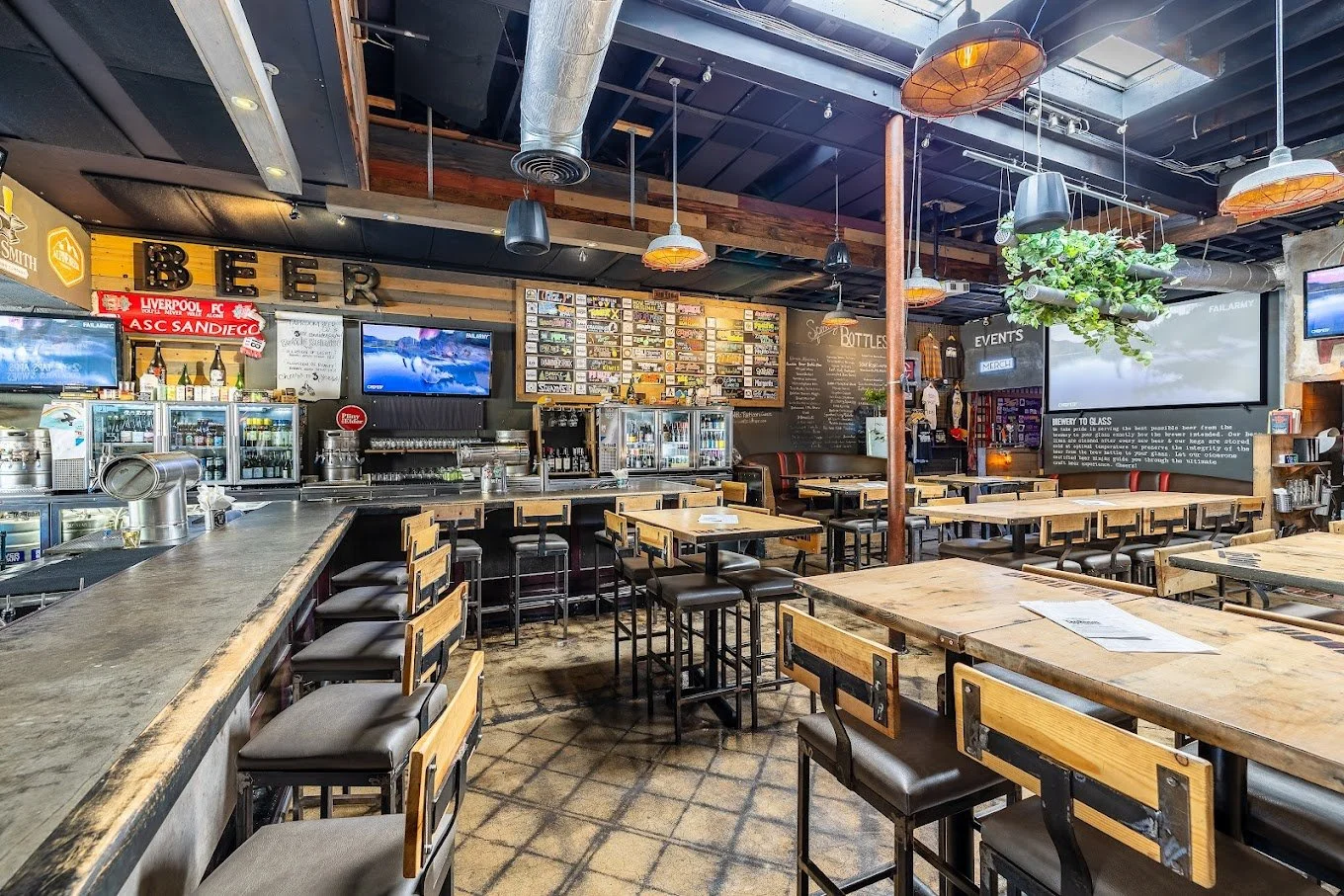

Becoming a taproom regular is only partly about what is in the glass. Most serious market work now treats solid beer as the table-stakes layer and folds the rest of the visit—sound, staff, food, how the room feels, whether the group can all order something they want—into the same conversation as revenue and return visits. Drinkers say the same thing in blunter terms: the list still has to be worth the drive, but a loud, indifferent, or snack-only room costs repeat business even when the taps are fine.
This piece draws together three strands: a sprawling r/CraftBeer thread from April 2026 built around the “one thing besides the beer” question; BevWire’s own taproom research from early 2026, where we line up third-place thinking with staff engagement, food, acoustics, and digital ordering; and short correspondence from Tom Canning at Siren Craft Brew and from Jason Sharon on running a rooftop bar abroad. That research is not academic literature, and its percentages will not mirror every market, but it gives a useful frame next to a forum that does not care about your slide deck. In the excerpts below, the thread itself did the sorting: either a comment took over the room, or the same gripe kept coming back as the branches grew.
“Regulars” are not one type of customer. Our research sketches several personas (social gatherers chasing vibe and outdoor space, food-first visitors, and others). The thread makes the same point in messier form: two people can call the same brewery “their spot” for opposite reasons. What follows is our read of that thread alongside what we have been seeing in the field and in the data.
Sound and conversation
The reply that ran away with the thread said it plainly: people want to hold a conversation without shouting.
As u/Free_Four_Floyd put it in the r/CraftBeer discussion:
An atmosphere that allows you to talk, not yell, with your party.
Underneath, the same worry echoed in smaller type. u/beerbrained asked how drinkers are supposed to discuss beer over loud music and proposed a quieter room inside with louder music or programming outside. u/Zanderson59 stayed on the problem rather than the fix, arguing that blasting music or hosting loud acts inside “sucks for conversations.”
In our taproom research, acoustics and noise sit among top consumer priorities, and we treat loud music and “playground” atmospheres—in the shorthand we use for rowdy, kid-heavy rooms—as deterrents for would-be regulars. That same research leans on the third-place idea: a social setting outside home and work where talking is the main activity. Sound treatment and volume choices are part of that experience, not a separate aesthetic choice.
Staff and service
If acoustics owned the top of the thread, hospitality owned the next shelf. u/Mikesiders kept it simple: friendly staff and a welcoming environment. u/sloh tightened the requirement to knowledge and real curiosity about the list:
Friendly AND knowledgeable staff. Being served beer from someone who's just as curious or excited about the tap list as I am will bring me back.
Our numbers tie high staff engagement to about a fifteen percent increase in guest spending versus neutral engagement and to recommendation and return intent above ninety-nine percent. u/Fearless_Tea2463 treated a rude bartender as a reason not to return when other breweries are nearby; u/Few-Dragonfruit160 lumped rudeness in with indifference and asked for eye contact at the bar. Variations on that gripe surfaced all over the thread.
We also see about a forty percent drop in measured staff engagement in the first quarter of 2026 versus the fourth quarter of 2025, with service described as friendly but missing engagement touchpoints. In our sample, recommendations occur on fewer than half of visits and to-go beer is rarely suggested. Those are operational gaps, not glassware issues, but they shape whether a visit feels helpful or purely transactional.
Tom Canning — Siren Craft Brew, correspondence with BevWire, April 2026
A good team behind the bar, welcoming, friendly and knowledgeable is an absolute must.
It takes time to build relationships in any walk of life, but I am much more likely to be a regular somewhere if I like the vibe of the people who run the place.
Food, nondrinkers, and licensing
Food never carried the same weight as the acoustics debate, but it refused to leave the room. u/Mitchford stated a common limit:
Real food. I can’t do these places with just snacks. If I want to drink a few beers I want something real in my stomach beyond pretzels
u/ski_hiker said that for a nearby brewery with mediocre beer, reliable food trucks could still be the main draw, while better beer justified a longer drive. u/UnfilteredJack described rotating trucks as supporting two local businesses in one stop.
We treat food as a revenue multiplier, link eating on site to longer stays, and see higher food spend paired with roughly the same or slightly higher beer consumption in the aggregate, not less. Operators who rely only on snacks or a cooler may lose visits from guests who want a full evening.
Mixed groups raise licensing and menu questions. u/Peeeeeps used “options for everybody,” describing a brewery limited to its own alcoholic products and weak house wine and cider while a competitor two miles away carried credible guest wine, seltzer, and draft cider. The story landed with roughly the same force as the stronger food takes. Industry commenters answered with state-specific constraints. u/TB1289 outlined Massachusetts-style rules where expanding beyond beer can conflict with distribution; further downthread, u/Best_Look9212 spelled out license costs and mixed-license limits in detail, shifting the blame from indifference to economics for anyone still reading. When one guest has nothing acceptable to drink, the group often picks another venue regardless of the beer quality.
Cleanliness, parking, and information
Upkeep and logistics never stole the headline, but they kept resurfacing. u/Beaverhuntr tied repeat visits to a clean, organized room. u/Skoteleven put parking immediately after beer quality on their personal list:
Besides the quality of the beer parking is the most important thing. I know warehouse/industrial space is cheap but generally it really sucks when it comes to parking.
Poor parking or a frustrating arrival often carries into the rest of the visit.
Other replies wandered through seating, outlets, water stations, and whether the tap list online matches what is actually pouring. u/sms8771 asked for a reasonably current tap list on the web; the same impatience showed up whenever someone said they had checked the menu in the car and still guessed wrong at the bar. Our research points to digital menus and mobile ordering as ways to reduce “what is on tap” confusion, improve order accuracy, and raise average checks. Those tools complement, rather than replace, in-person service.
Children, dogs, and programming
There was no consensus on family or pet policy. u/Emergency_Scarcity64 drew a bright line between parents having a beer and letting the brewery double as a playground. u/solomons-marbles answered in two words—“No kids”—and picked up about as much agreement as the louder food complaints. u/xMoop described kid-friendly layouts with changing tables and space; u/AliveInCLE argued food-serving breweries will still take family traffic as beer sales soften.
On dogs, u/mwinni listed dog-friendly outdoor areas among positives; u/kaydeechio preferred no dogs, citing personal space issues. On events, u/Marty_Mac_Fly said recurring trivia and open mics interfered with quiet catch-ups, while u/J1P2G3 called televised sports an underused draw. Most people simply route themselves to the room that fits the night they had in mind, whether that is a quiet table or a game-day crowd.
What “regular” means in the thread
Few posters laid out the arithmetic as clearly as u/4RunnaLuva, who sorted repeat visits into three bands: “S tier” beer was enough on its own; “A tier” beer needed more (food nearby or other draws); anything below that needed a strong secondary reason to return. They defined “regular” as about weekly or several times per month.
u/TheGreatKane58 described a Dallas-area taproom where community and familiarity kept two friends coming back despite beer they considered only okay. That matches how we frame the third-place idea in our own work. It is the sort of aside easy to scroll past, but it names the neighborhood-bar effect several people gestured at without quite spelling it out.
International note
Jason Sharon, in correspondence with BevWire about a rooftop bar in Thailand, said simple table games (Connect Four and a dice game similar to War) were consistently popular with guests. That is one market’s experience and not a template for every U.S. taproom.
Summary
Taken together, the thread and our research point to the same operational list: manageable noise, engaged staff, food or credible options for nondrinkers where law allows, clean and legible spaces, workable parking, accurate tap information, and clarity on who the room is for (families, adults-only evenings, dogs, televised sports, or quiet tables). The numbers add structure on engagement, spend, and return intent; the thread supplies the language people use when they are done being polite. No single answer fits every customer, but the overlap is large enough to read as a pattern, not a fluke.
For related BevWire coverage, see What Drinkers Notice First on Beer Packaging, Most Important to Least.
Sources
- r/CraftBeer — reader discussion thread titled Aside from the beer, what is the one thing a taproom needs to have to make you a regular? (April 2026). If the search link shifts as posts age, use Reddit’s search within r/CraftBeer for the post title or author u/RutabagaTechnical822: https://www.reddit.com/r/CraftBeer/search/?q=Aside+from+the+beer+one+thing+taproom&restrict_sr=1&type=posts
- BevWire — taproom customer experience research, Optimization of the Taproom Customer Experience (2026). Statistics and themes cited above come from that work.
- Siren Craft Brew — https://www.sirencraftbrew.com/
Context
- Tom Canning is quoted with permission from private correspondence with BevWire in April 2026.
- Jason Sharon’s note on table games reflects private correspondence with BevWire in April 2026 about hospitality in Thailand and is included as geographic context rather than a universal prescription for U.S. taprooms.