
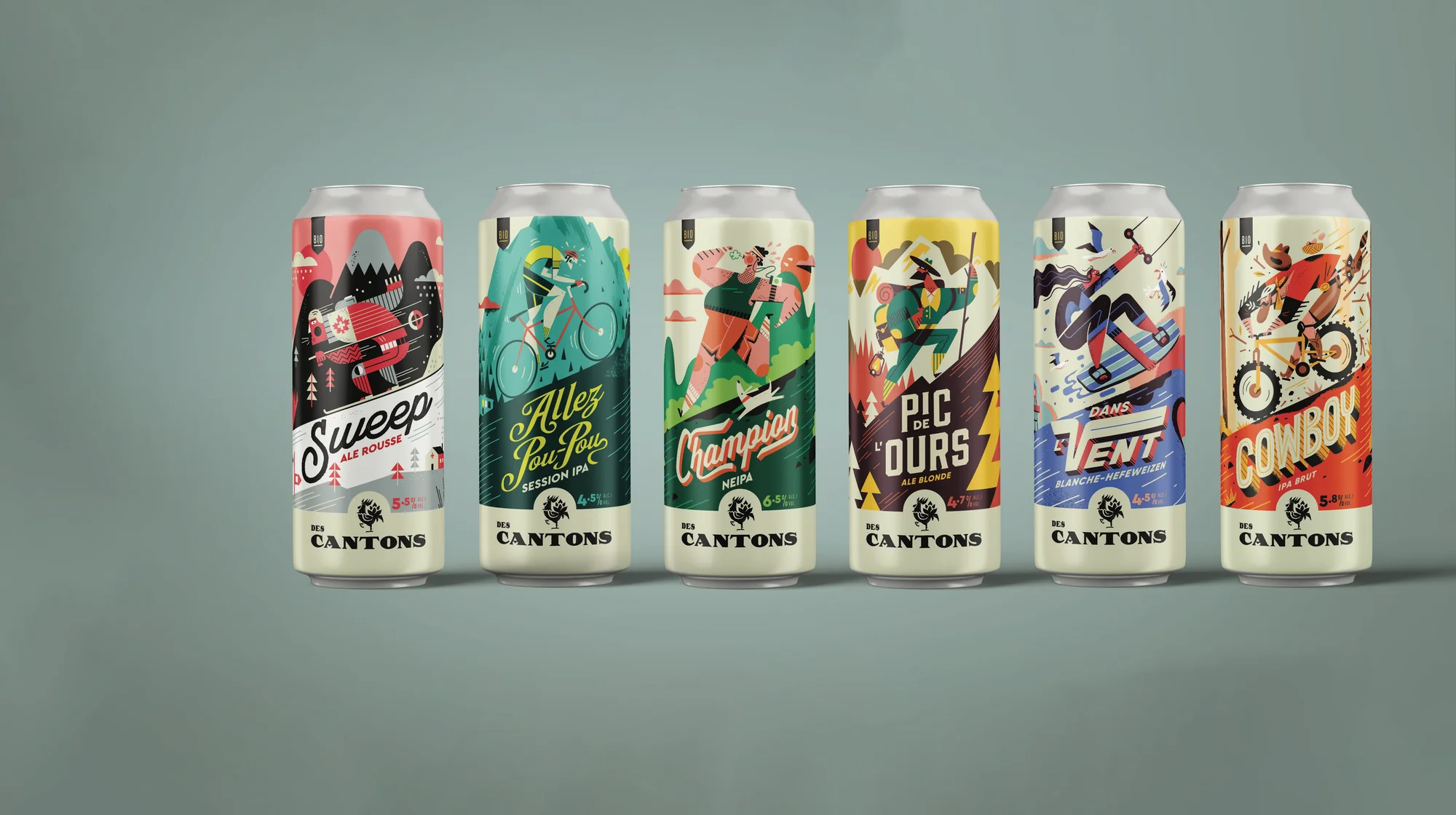

When you are standing in front of a cooler or a singles wall, you are not conducting a design jury. You are trying to answer a few practical questions fast enough that the person behind you can still reach the door. Does this beer look fresh, does it look like something I want to drink tonight, and can I tell what it is without opening my phone? The breweries that win that moment are usually the ones that treat the label and the can as a piece of communication first and a portfolio piece second.
This article lays out what we think matters most to least when packaging is trying to turn a glance into a sale. It is not a scientific ranking; it is an editorial read of what showed up again and again when we asked drinkers, in public, what they actually use on the shelf. Federal rules still set a floor for what malt beverage labels must carry. TTB walks producers through how mandatory information is supposed to appear on malt beverage packaging, and the Brewers Association is the main U.S. trade body for independent craft brewers, with extensive public and member resources on running a brewery brand in retail, so we are not pretending shelf behavior exists in a vacuum outside compliance and trade norms.
If you are a designer or a brand manager, the uncomfortable part is that the cooler is a hostile reading environment. Lighting is uneven, people are half-turned away from the shelf, and half the SKUs are trying to shout over each other. In that setting, “we will explain it on Instagram” is not a packaging strategy. Instagram is for after someone already cares. The label and the can have to do the first pass of education in a second or two, which is why we are ordering ideas by urgency rather than by how fun they are to art-direct.
Harrison Hickok — Beer Me That Movie, exclusive private correspondence with BevWire, April 2026
- If there is no born on or canned on date I am out, 100 percent of the time.
- [Great](/beer/reports/pint-sized-paradox-great-beer-least-important-brewery-success-2026) if you list the hops, malt, and yeast.
- Great if you list the artist that made the label.
- If you highlight that you have won a GABF or WBC medal then you will hook me and make me pick up your beer, to then look for number one.
The same checklist also appeared in the public discussion on r/CraftBeer under the account u/beermethatmovie.
Freshness and dating
If Hickok’s first point sounds harsh, it matched the temperature of a lot of the thread. People who spend their own money on craft beer have learned, often the expensive way, that “cold stored” is not the same thing as “recently packaged.” Hop character fades, oxidation shows up, and stale inventory sits on shelves at stores that move volume on other categories—packaging choices matter here too, as green bottle lightstrike shows when glass color works against the “drink fresh” promise on the label. When a drinker says they will not buy without a date, they are not asking for a typography exercise. They are asking for a signal that the supply chain is honest.
That expectation showed up in many forms in the wider conversation. Some people ranked freshness ahead of style and origin. Others said they might forgive almost anything else if the beer came from a brewery they trust, but still wanted the date before they would commit. A frustration that surfaced more than once was cans that scream “drink fresh” in big type and then never print a packaging date anywhere you can find without a magnifying glass. If you are going to borrow the language of urgency, the package needs to earn it.
From a production standpoint, dating is also one of the few things you control all the way to the cooler. You pick the ink, the placement, and whether the consumer sees it without rotating the can. Making it legible is part of respecting the person who is about to spend eight or eighteen dollars on something they cannot taste first.
Trust and identity
Once someone believes the beer might be fresh, the next question is usually “who made this and do I know them.” Trusted brewery names function like shortcuts through the wall of novelty. Local loyalty still matters to a meaningful slice of drinkers who said they try to support producers near home even when the art is not trying to stop traffic.
Legibility matters here in a very literal way. A few commenters mentioned wanting the beer name and brewery name written clearly enough that they could look the beer up on Untappd or another app without guessing spelling from a script font buried in illustration. That is a useful design test: if someone can read your label aloud once and find the beer online, you have probably passed a hurdle that a lot of packaging fails.
There is also a softer kind of trust that does not show up in a spec sheet. When the type hierarchy makes sense and the legal line does not look like an afterthought squeezed into a dead zone, people read it as competence. When the brewery name is hidden inside a busy illustration or treated like an Easter egg, they read it as a brand that is still figuring out who it is. Neither reaction is fair every time, but retail is not fair either.
Style, ABV, and whether the package tells the truth
This is where Zouaoui’s framing lined up with what many r/CraftBeer posters said in blunter language. He looks for an ABV range and whether it matches the style, because that combination is the fastest signal for him of whether the beer will feel balanced and drinkable or like a statement beer that runs hot, heavy, or boozy in a way that does not fit the night he had in mind.
(1) I look for an ABV range (and whether the style matches it). It is the fastest signal of whether the beer will be balanced and drinkable for me, or whether it is likely to be a "statement" beer that is hot, heavy, or overly boozy.
(2) In practice, that indicator has taught me that when the ABV is aligned with the style (for example, a pilsner or lager staying crisp and moderate, or an IPA not creeping into double IPA territory), I am more likely to enjoy it and order it again. When the ABV is high for the style, it is often a one-and-done: interesting to taste, but less likely to fit a longer, more social drinking occasion.
Damien Zouaoui, cofounder of Oakwell Beer Spa, exclusive private correspondence with BevWire, April 2026.
Several Reddit voices echoed the same operational idea from the shelf side: if they cannot determine style and ABV quickly, they move on. One person said they barely look at stylistically busy cans because the information they need is not surfacing through the noise. That does not mean minimalism is always right; it means hierarchy is. Style and ABV are not decorative flourishes for a large share of your buyers. They are the headline.
As u/Docrandall put it in the r/CraftBeer thread:
All I care about it the style of beer and the ABV. If I cannot easily determine either thing I don't buy the beer. I barely look at really stylistically busy cans.
We left the wording as it appeared in the comment. The sentiment is the point: busy art without clear style and ABV is not neutral. It is a conversion leak.
Ingredients, specificity, and the AI-art backlash
Listing hops, malt, and yeast is not mandatory for every package in every market, but it is increasingly part of how serious drinkers triage IPAs, lagers with varietal character, and adjunct beers where the selling point is the ingredient story—readers who want the gap between label poetry and what is actually in the glass should see what shows up on flashy cans versus your pantry. Hickok’s second and third points fit a broader pattern we saw: people want to know what went into the beer and, separately, they like seeing the human who made the art credited by name. Giving an illustrator a line on the label costs almost nothing in print and reads as confidence.
The same stretch of discussion included a harder edge. Multiple commenters said they avoid beer that uses obvious AI-generated artwork, some in language strong enough that it sounded like a permanent boycott rather than a preference. Whether or not you agree with that stance, it is real consumer sentiment in 2026, and it sits in the same bucket as specificity. AI slop reads as anonymous, and anonymous is the opposite of what craft has traditionally sold.
A representative line from the thread, from u/LaserBeamHorse in the same r/CraftBeer discussion:
IPA's should have hops listed.
No AI art.
Short, but it captures two themes that kept recurring.
Visual pull when the basics are already met
Once dating, identity, style, and ABV are doing their jobs, art and humor start to act like accelerators. People admitted, cheerfully, to being suckers for terrible puns. Others said flatly that a cool-looking can beats a bland one if everything else is equal. Pop culture references, clever names, and memorable illustration still move product.
Retail experience crept into the thread through the official Tavour account, which is worth treating as a platform perspective rather than a single anonymous drinker. In a long comment, Tavour described patterns from moving thousands of SKUs: pop culture riffs that land on recognizable franchises, adorable animals on labels, collaborations with strong visual artists, and non-standard bottle shapes or smaller can formats sometimes outperforming comparable beers when other factors are held roughly equal. They also flagged what hurts: obvious AI artwork, and labels that feel cheap or cartoonish on high-price barrel-aged releases where buyers expect a premium visual language.
That last tension is worth sitting with for a moment. The same buyer who will forgive a silly pun on a fruited sour might feel cheated if a fifteen-dollar barrel-aged stout looks like clip art. Price sets expectations, and the label is part of the promise. When the promise and the price disagree, people do not always articulate it as a design critique. They say the beer “felt expensive for what it was,” which is a packaging problem even if the liquid was flawless.
Tie-breakers, apps, and honest disagreement
Medals and competition wins showed up as a classic hook: enough to get a pick-up, not enough to skip checking the date. Hickok said as much in his fourth point, and it matched how other people described GABF or WBC callouts working as a first nudge before they did their real diligence.
Not everyone uses the package as the primary interface. Some people said they default to Untappd ratings or other apps, which is a useful reminder that the label is one channel in a wider system. Others said they avoid anything that says IPA, which is a good counterexample: no rule here applies to every buyer, and your actual audience might care about different signals than the loudest thread regulars.
A few voices cared about barrel aging callouts, barrel time, or phrases like “barrel-aged” as shorthand for the experience they were hunting. That sits lower on our list only because it showed up narrower than dates and ABV, not because it is unimportant to the people who care about it.
If you take one practical checklist away from this piece for your next packaging pass, it might look boring on a creative brief: date visible without a scavenger hunt, brewery and beer name readable at a glance, style and ABV in the same visual neighborhood, ingredients where they help the buyer decide, art that signals humans were involved, and premium cues that match the price. Everything else is still worth doing, but it works better when those boxes are already checked.
Additional private correspondence
The following notes are from exclusive communications with BevWire in April 2026. They are not excerpted from the r/CraftBeer thread cited above.
Andrew Gazdecki (CEO, Acquire.com) said he picked up a pale ale because ABV and flavor callouts were legible without squinting, and that trimming busy artwork in favor of what is in the bottle would get him to try more unfamiliar beers. Amanda New, founder of Cash For Houses Girl, pointed to high-contrast type for ABV, tasting notes visually separated from hop detail, and packaging that prioritizes function over ornament as what signals careful production. Adam New, principal owner of The Cash Offer Company, tied a clear visual order for style and tasting notes to fast ABV and IBU scanning, and still credited bold color or illustration for the initial shelf grab.
Sources
- r/CraftBeer — reader discussion thread (April 2026): https://www.reddit.com/r/CraftBeer/comments/1se72bz/
- Alcohol and Tobacco Tax and Trade Bureau (TTB) — anatomy of malt beverage labels (official overview of how label information is structured for compliance): https://www.ttb.gov/regulated-commodities/beverage-alcohol/beer/labeling/anatomy-of-a-malt-beverage-label-tool
- Brewers Association — U.S. trade association for independent craft brewers (resources on operations, brand, and retail): https://www.brewersassociation.org/
Context
These links are background on the named contributors; they are not the citation for the private correspondence quoted above.
- Oakwell Beer Spa — https://oakwell.com/
- Beer Me That Movie — https://beermethatmovie.com/
- Acquire.com — https://acquire.com/