
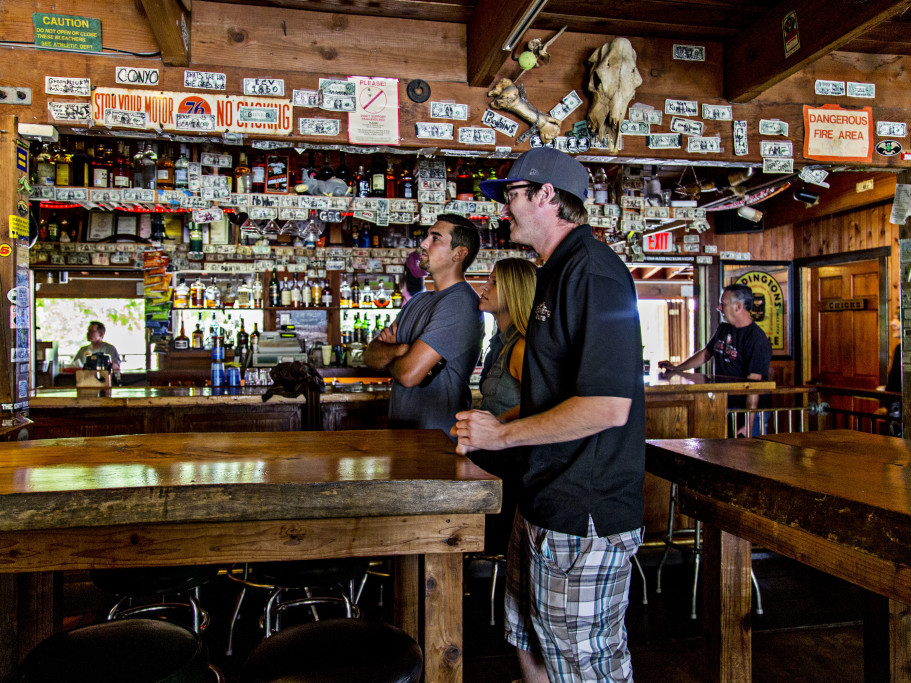

If you find yourself driving along River Road in Guerneville on a sunny afternoon, you might notice a modest building with a deck stretching toward the Russian River, picnic tables scattered under the trees, and the kind of relaxed energy that makes you want to pull over immediately. This is Stumptown Brewery, and it has been serving craft beer to locals and tourists alike for more than two decades from a location that feels like it could only exist in Sonoma County. The brewery sits on 15045 River Road, occupying a former deli and convenience store that the owners transformed into a rural pub with a view that rivals any wine tasting room in the region.
The story of how Stumptown came to be starts not with a business plan or venture capital, but with two friends talking over beers in 1990. Brian Johnson was working as a stockbroker and brewing beer at home as a hobby, while Peter Hackett had just returned from Australia where he had been studying to become a programmer. The two of them would get together, drink a few beers, and occasionally find themselves under the table, all while dreaming about turning their shared passion into something real. Their vocations practically demanded it, or at least that is how it seemed after a few pints. Brian understood the business world from his time in finance, and Peter had experience managing bars in both Australia and San Francisco. It felt like the pieces were there, even if they did not know exactly how they would fit together.
Walter's Hop Ranch near Healdsburg, c. 1918. The Russian River Valley was once a major hop-growing region, a history that Stumptown's founders embraced. Photo: Western Sonoma County Historical Society Collection.

The Planning Years and the 1996 Opportunity
For six years, the brewery remained a conversation piece. Brian continued brewing at home and keeping tabs on the growing microbrew industry, while Peter pursued his programming education in Australia. Then in early 1996, everything changed. Peter returned from Australia ready to take on the tech world, while Brian faced a decision at his firm. The company offered him a choice: accept a healthy severance package or transfer to what he considered professional purgatory. Suddenly, both friends found themselves with the time and resources to pursue the project they had been discussing for years.
They started doing serious research. Brian had already been tracking the industry, but now they needed to get methodical. They visited brewpubs up and down the state, asking questions and taking notes while doing plenty of tasting along the way. The research phase was thorough, perhaps too thorough, as they sampled their way through California's emerging craft beer scene. They connected with Bill and Don at Powerhouse Brewery in Sebastopol, who provided valuable guidance and would later play an unexpected role in the equipment acquisition.
Their original plan was deliberately simple. They wanted to minimize risk by starting small. The idea was to build a large homebrew system, find cheap warehouse space in Hunter's Point in San Francisco, get the necessary permits, and start brewing. They would let the business pay for its own growth rather than taking on massive debt upfront. It was a pure approach, almost naive in its simplicity, but it reflected their limited resources and cautious nature.
From Warehouse Dreams to a Movie Theatre in the Redwoods
Sometimes the best plans fall apart in ways that lead to something better. The two friends heard about a vacant building up north, an old rural movie theatre from the 1940s that had been converted into a dance club called The Jungle and later Ziggurat. At first, Peter thought the idea was too far removed from their warehouse plan. The building was massive, around 6,000 square feet with 30-foot ceilings, and located in Guerneville, a town neither of them knew well. The place seemed like it would require more resources and complexity than they were prepared for.
But after visiting Powerhouse Brewery in Sebastopol, Brian convinced Peter they should at least investigate. The Powerhouse visit proved pivotal. Don mentioned that equipment from San Rafael Brewing was about to hit the market at a reasonable price. The system included a 3.5-barrel brewhouse, nine 7-barrel grundies, pumps, heat exchangers, mills, hoses, and all the fittings needed to get started. Don had actually used that same equipment when he was brewmaster at San Rafael, so he could vouch for its quality. Within minutes, Brian and Peter were on the phone making an appointment to see it.
The equipment negotiation took about a month, but they eventually secured everything at a price they could afford. They also picked up the grain silo from San Rafael Brewing. Part one of their plan was complete. They now had a large, jerry-rigged homebrew system that could produce professional-quality beer.
The Legal Maze and the Zoning Nightmare
One of the main reasons the founders initially wanted a microbrewery instead of a brewpub was their fear of dealing with food service. California law required on-site kitchens for brewpubs, and the license restricted sales to beer and wine only. They wanted to avoid the restaurant business entirely. But during their research, they discovered a crucial change in California law. As of January 1, 1996, the restriction preventing a microbrewery and bar from operating as separate entities on shared premises had been lifted. As long as the two operations were separated by a partition, a full liquor license holder could legally brew beer in one area and sell it in the bar across the room.
This discovery made the Guerneville theatre location suddenly seem more viable. They visited the town and found the locals welcoming. The Guerneville Chamber of Commerce, shop owners, and residents all seemed enthusiastic about having a brewery in town. The building owner offered them reasonable rent with a fifteen-year lease, and they decided to move forward, assuming the zoning would work out.
That assumption nearly ended the project. The Sonoma County Permit and Resource Management Department initially told them zoning should not be a problem. The building department confirmed there had been no major code changes since the previous occupant applied for their use permit in 1992. Based on these assurances, they signed the lease. They should have waited.
It turned out they would need to spend at least $20,000 to bring the building up to code, including splitting the building with a fire wall. If they wanted to use the space as planned, they would be out closer to $70,000. The county building department required a fire sprinkler system that the theatre had never needed as a dance club. After six months of negotiation with the local fire chief, they reached a compromise where they could operate immediately if they committed to installing sprinklers over five years. But the building department refused to accept this arrangement.
The Move to the River and Starting Over
The founders faced three unappealing choices. They could stay and drop a fortune to satisfy the county, convert the space back to a dance club, or sell at a discount and move on. The bureaucracy and petty politics they encountered had worn them down, but they both still wanted to open a brewery.
About a mile and a half east of Guerneville, they found an alternative that would turn out to be a blessing in disguise. The new location was a former deli and convenience store called The Midway Deli, situated on River Road with a deck overlooking the Russian River and access to their own two-acre beach. The building was smaller, around 2,200 square feet, but it had everything they actually needed: better lighting, easier maintenance, plenty of parking, and that spectacular view.
They took occupancy on March 3, 1997. Unfortunately, the zoning issues meant they had to start the permit process over again. At this point, Brian had reached his limit with the bureaucracy and decided to move on to other opportunities. Peter continued the process alone, navigating the ABC and ATF requirements while adapting to their new location.
The liquor license transfer went relatively smoothly, and they applied for their small beer manufacturer license at the new location in December 1996. The ATF investigator in Santa Rosa happened to be a dedicated homebrewer, which helped immensely with the complex paperwork. After the ATF finalized the change of location and inspected the equipment, the paperwork went to Sacramento. They received their brewery license on April 16, 1997.
The Equipment Evolution and Professional Help
The original San Rafael equipment was always meant to be temporary. They had planned to expand from the 3.5-barrel system as soon as possible. But before they even brewed their first batch, an opportunity appeared that would change their trajectory.
Brian Hunt from Moonlight Brewing stopped by one day and took one look at their brewhouse. He laughed. It was a valid reaction. The setup was makeshift, the kind of system that might work for a serious hobbyist but would strain under commercial production demands. Between laughs, Hunt mentioned a nearly complete 7-barrel brewhouse that had been sitting in a welder's garage for five years.
A project in Cloverdale had fallen through, and the welder, who had never been paid, had stored the equipment all this time. Apparently, five years was his wife's limit for tolerating a brewery system in their garage. He needed it moved immediately. Peter and Brian Johnson, along with Hunt, went to inspect it that same day. Hunt confirmed the equipment was solid, and they negotiated a deal that very afternoon. The welder's only non-negotiable term was that it had to be gone yesterday.
They took the system to Quality Stainless to be completed, and the resulting brewhouse has worked reliably ever since. This upgrade gave them the production capacity they needed to actually serve a customer base, moving from a proof-of-concept to a viable business.
The Taproom Opens and the Beers Flow
Stumptown Brewery officially opened its doors in 2001, more than a decade after those first conversations over homebrew. The delays had been frustrating, but the location on River Road proved worth the wait. They applied for their full liquor license in July 2002, which cleared in mid-September of that year, allowing them to offer single malts and cigars alongside their beers.
The first beer they brewed was Rat Bastard Pale Ale, and it immediately established their reputation. The beer won a Blue Ribbon at the California State Fair, validating their approach before they had even fully found their rhythm. The name, according to the brewery, named itself, though regulars will tell you it was named in their honor.
Beer writer Jay Brooks of the Brookston Beer Bulletin described the Rat Bastard as a well-made pale ale with good aromas and a crisp, clean palate. He noted its generous hop bite that finishes bitter, then drops off sharply. At just under 6 percent alcohol by volume, it functions as an ideal session beer with a clean dry finish. The hop profile is balanced enough to be crisp on the tongue without overwhelming the malt character, and it carries pleasant floral and citrus notes to the nose. The brewery's favorite review came from a customer who simply said, "This tastes like beer."
The Kruger Era and Professional Brewing
Peter Hackett knew how to run a bar and manage a business, but he needed help learning to brew at a professional level. In June 2001, he hired Peter Kruger as the brewery's first professional brewer. Kruger came with experience and a direct teaching style. When Hackett asked if Kruger could teach him to brew, Kruger replied, "I could teach a monkey to brew," and was hired on the spot.
Kruger brought significant experience to Stumptown, having previously worked at Bear Republic Brewing Company where he won a 1999 Great American Beer Festival Gold Medal for Racer 5 IPA. He stayed with Stumptown until late 2005, when Bear Republic offered him a real, paying job that Stumptown simply could not match. His departure marked the end of Stumptown's first professional brewing era, but by then the systems and recipes were established enough to continue.
Peter "The Scrubber," who had been working alongside Kruger, took over the brewhouse with a raise that included both beer and nuts. The brewery continued its rotation of styles, maintaining the house beers while experimenting with seasonal offerings.
The Modern Era: Manuel Mussen Takes the Helm
In July 2017, Stumptown brought on Manuel Mussen as Brewmaster, marking a new chapter in the brewery's professional brewing history. Mussen arrived with formal brewing credentials, having earned a Bachelor of Science in Brewing Science from UC Davis in 2010. He brought over fifteen years of brewing experience to the role, including previous positions as Head Brewer at Old Redwood Brewing Company and Nexus Brewery in Albuquerque.
Mussen's appointment represented a shift toward a more credentialed approach to the brewhouse while maintaining the casual, experimental spirit that had defined Stumptown since its founding. With a dedicated Brewmaster overseeing production, the brewery has continued to evolve its offerings, adding modern styles like Post Hazy IPA alongside the established core lineup. Peter Hackett remains involved in operations, and Peter "The Scrubber" still works at the brewery, creating a continuity of personnel that spans the brewery's entire history.
The Beer Lineup and Guest Philosophy
Today, Stumptown maintains a core lineup of house beers supplemented by rotating seasonal offerings and guest taps. The flagship remains Rat Bastard Pale Ale, the beer that started it all. Alongside it, Boot Legger IPA and Bushwacker Wheat provide options for different palates and preferences.
The rotating lineup includes creative names that reflect the brewery's personality. Dirty Rat IPA offers a more aggressive hop profile, while Clear Cut Brut IPA brings a drier, more modern approach. Stable Genius ESB provides a traditional English style, and Squirrel Tickler Cream Ale offers something lighter and more approachable. Old Purple Stump Alt Bier draws on German brewing traditions, and Donkey Punch Pils delivers a crisp lager experience. For darker beer fans, Black Otter Porter and Goat Roper Bock round out the options, while Red Rat Amber Ale and Bush Pig Pub Ale provide malt-forward alternatives. Recent additions include Pixilated Porter and Post Hazy IPA, showing the brewery continues to evolve with changing tastes.
What sets Stumptown apart from many small breweries is their guest tap philosophy. Rather than trying to brew every style in-house, they maintain relationships with neighboring breweries and bring in beers from Lagunitas, Russian River, North Coast, Moonlight Brewing, and Golden State Cider. They even keep PBR on tap for those who want a straightforward domestic lager. This approach gives customers genuine variety while acknowledging the practical limits of a small production facility.
The Russian River Experience
The current location offers something the original theatre never could have provided. The deck overlooks the Russian River, with seating that lets customers watch the water flow past while they drink. Walkways lead down to a grassy area by the river, and the property includes two acres of beach access. The setting is dog-friendly, with a fenced area where pets can relax while their owners enjoy a pint.
The food menu has evolved over the years from the original fear of running a kitchen to a full pub offering. Burgers remain the staple, along with fish tacos, fish and chips, and vegetarian options. The kitchen operates seasonally, typically from 11:00 a.m. to 9:00 p.m., closed on Tuesdays. They now accept credit cards, a change from their earlier cash-only days.
Hours run from 11:00 a.m. to midnight most days, staying open until 2:00 a.m. on Fridays and Saturdays. Sunday hours start at 10:00 a.m., accommodating those seeking a leisurely start to their day by the river.
The Place and Its History
The name Stumptown connects directly to Guerneville's history. The area was once part of an ancient redwood forest that was logged extensively in the late 19th and early 20th centuries. After the deforestation, the remaining stumps gave the town its nickname. Local industry shifted to agriculture and tourism, and one of the major cash crops turned out to be hops. The Russian River Valley was a significant hop-growing region, and remnants of that era still exist. Walter's Ranch Hop Kiln, a stone structure built in 1905 for drying hops, stands on Westside Road and is listed as California Historical Landmark No. 893. Stumptown pays homage to this agricultural history simply by existing in the region and brewing beer where hops once grew commercially.
The roads around Guerneville add to the experience. Highway 116 runs through town, connecting to the Pacific Coast Highway about twenty miles west. The back roads that honeycomb the area were built when civil engineers designed for the terrain rather than for recreational vehicles, creating winding routes that motorcyclists particularly enjoy. Getting to Stumptown can be half the experience, especially on a sunny afternoon with the right vehicle.
What Patrons Say About Stumptown
On Untappd, Stumptown maintains a 3.46 overall rating based on over 5,300 ratings, with 6,481 total check-ins from 3,435 unique users. The platform lists 35 different beers from the brewery, showing the range of their production. Individual beer ratings vary, with the Rat Bastard Pale Ale generally receiving positive marks for its balance and drinkability.
Google reviews give the brewery 4.0 stars from 396 reviews, while Yelp shows 3.3 stars from 491 reviews. Jolly Pint users rate it 4 out of 5 stars from 361 reviews. The variance in ratings reflects the reality of a small, casual operation that prioritizes character over polish.
Reviewers consistently mention the riverside location as a major draw. The outdoor seating, dog-friendly policy, and casual atmosphere appeal to those looking for a relaxed afternoon. The fish tacos and burgers receive regular praise, though some reviewers note the food can be hit or miss. Service quality varies by day and staff, which is typical for small, independently owned establishments in tourist towns.
What comes through in the reviews is an appreciation for authenticity. Stumptown is not trying to be a polished tourist destination or a slick marketing operation. It is a brewery that grew out of conversations between friends, survived bureaucratic nightmares, and found its place along the Russian River through persistence rather than perfection.
The Legacy of Persistence
Stumptown Brewery represents what happens when determination outlasts obstacles. The project started as bar talk in 1990, became a serious plan in 1996, nearly collapsed under zoning and permitting issues in 1997, and finally opened in 2001. Brian Johnson left early in the process, but Peter Hackett continued through the legal maze and equipment acquisitions to establish a brewery that has now operated for over two decades.
The original vision of a simple warehouse operation in Hunter's Point never materialized, but what emerged along the Russian River has something better than simplicity. It has character shaped by the struggles of its founding, a location that connects to the agricultural history of the region, and a beer lineup that reflects both consistency in the core offerings and willingness to experiment with seasonal rotations.
The Rat Bastard Pale Ale, named in a moment of founder exhaustion or inspiration depending on who tells the story, remains the flagship for good reason. It is a straightforward, well-made beer that does exactly what it promises. The Blue Ribbon from the California State Fair validated their approach in the early days, and the beer continues to anchor their tap list today.
Visiting Stumptown Today
Stumptown Brewery operates at 15045 River Road in Guerneville, California, about seventy miles north of San Francisco in Sonoma County's Russian River Valley. The location offers outdoor seating with river views, a dog-friendly environment, and a menu of burgers, tacos, and pub fare.
Hours run 11:00 a.m. to midnight Monday through Thursday, 11:00 a.m. to 2:00 a.m. Friday and Saturday, and 10:00 a.m. to 11:00 p.m. on Sunday. The kitchen typically closes at 9:00 p.m. and is closed on Tuesdays, though these hours can vary seasonally. Credit cards are now accepted.
The brewery can be reached at (707) 869-0705 for current hours and kitchen availability. With its location on the Russian River, dog-friendly policy, and mix of house beers and guest taps, Stumptown offers a casual alternative to the wine tasting rooms that dominate Sonoma County tourism.
For current tap listings and events, the brewery maintains a website at stumptown.com, though it carries the charm of an earlier internet era, much like the brewery itself.
Single-brewery stories like this one sit inside a wider market shift—The Beer Paradox: Why Canada’s Favorite Brew is American While the … picks up the national context.
Sources
Stumptown Brewery. "The Saga." Stumptown.com. http://www.stumptown.com/saga.html (Accessed March 2026). The brewery's own history page documenting the founding story, equipment acquisition, legal challenges, and operational details from 1990 through 2009.
The Press Democrat. "Microbrewery Planned in Guerneville." May 16, 1996. https://www.pressdemocrat.com/1996/05/16/microbrewery-planned-in-guerneville/ (Accessed March 2026). Contemporary news coverage of the original theatre location plans, including details about Worldwide Pints Inc., the 3.5-barrel system, and the Memorial Day 1996 target opening.
Stumptown Brewery. "Rat Bastard Pale Ale." Stumptown.com Taps Page. http://www.stumptown.com/taps/rat.html (Accessed March 2026). Official description of the flagship beer, including Jay Brooks's review notes, alcohol content, and brewing history.
Untappd. "Stumptown Brewery." https://untappd.com/StumptownBrewery (Accessed March 2026). Rating data showing 3.46/5 from 5,363 ratings, 35 beers listed, and 6,481 total check-ins.
Yelp. "Stumptown Brewery." https://www.yelp.com/biz/stumptown-brewery-guerneville (Accessed March 2026). Customer reviews and ratings showing 3.3/5 from 491 reviews, with feedback on food, atmosphere, and service.
Google Maps/Reviews. "Stumptown Brewery." https://maps.google.com (Accessed March 2026). 4.0/5 rating from 396 reviews, with customer photos and location information.
Jolly Pint. "Stumptown Brewery." https://jollypint.com/us/ca/guerneville/stumptown-brewery (Accessed March 2026). 4/5 rating from 361 reviews with beer listings and atmosphere details.
Sonoma County Tourism. "Stumptown Brewery." https://www.sonomacounty.com/profiles/stumptown-brewery (Accessed March 2026). Official tourism profile describing the brewery as a "small brewery and rural pub" with rotating styles and Russian River views.
Wikipedia/California Historical Landmarks. "Walters Ranch Hop Kiln." Information on the historic hop kiln and California's hop-growing history in the Russian River Valley.
Manuel Mussen LinkedIn Profile. https://www.linkedin.com/in/manuel-mussen-86084613a (Accessed March 2026). Professional background showing UC Davis Brewing Science degree and Brewmaster position at Stumptown Brewery since July 2017.