
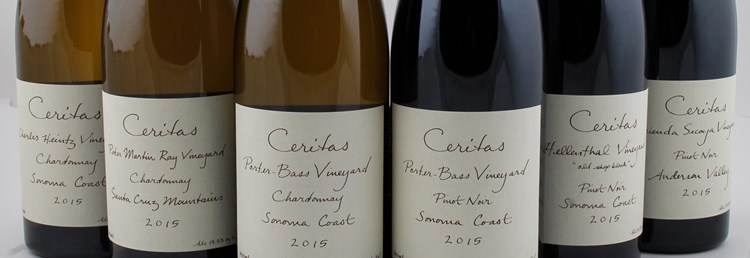

If you see Ceritas on a restaurant wine list or an auction site, you likely won't see a familiar logo or a mass-market varietal name. Instead, you'll see a specific vineyard—Porter-Bass, Occidental, or Peter Martin Ray—and a price tag that signals something rare.
Founded in 2005 by husband-and-wife team John Raytek and Phoebe Bass, Ceritas has become one of the most sought-after names in California for drinkers who value "transparency" over power. The name is often glossed as a reference to the mineral expression of the soil, and the project's mission is to uncover what a specific row of vines can say when the winemaker stays out of the way.
But because Ceritas operates primarily on an allocation model, these wines are rarely found on grocery store shelves. If you want to try them, you need a strategy.
Sixty-second producer facts
- The Team: John Raytek is the winemaker, having honed his skills at Flowers, Rhys, and Copain. Phoebe Bass directs the farming; she grew up on the Porter-Bass vineyard, which her family has farmed biodynamically since 1980.
- The Philosophy: Raytek uses indigenous yeasts, long fermentations, and old barrels. He avoids the "built" style of winemaking, preferring to let the site and season dictate the result.
- The Scale: Ceritas is a small-scale operation, producing roughly 4,000 cases (48,000 bottles) per year. This limited production is spread across roughly a dozen different vineyard sites.
- The Wood: Chardonnay typically sees no new oak at all, while Pinot Noir averages around 25% new oak. This restraint is a hallmark of the Ceritas style, designed to keep the focus on the fruit and the dirt.
How to actually buy Ceritas
You cannot simply walk into a standard retail shop and expect to find a vertical of Ceritas. Here is how the access model works:
| Channel | What to expect | Best for |
|---|---|---|
| Mailing List | Offers are sent via email three times a year. You sign up at ceritaswines.com and wait for an allocation. | Patient buyers who want the best prices and direct access to rare sites. |
| Restaurants | High-end lists in cities like San Francisco, New York, and Chicago often carry Ceritas by the bottle or glass. | Trying the wine before committing to a mailing list allocation. |
| Specialty Retail / Auctions | Retailers like Rare Wine Co. or K&L Wines occasionally receive allocations, and sites like WineBid are common for older vintages. | Hunting for a specific site or vintage without waiting for a release. |
Expect to pay between $60 and $120+ for current releases on the secondary market, depending on the site's prestige.
The Vineyard Map: Decoding the Labels
Every bottle of Ceritas is a record of a specific place. Here are the sites you are most likely to encounter:
| Site / Bottling | Region | Grape | Character (Trade Descriptions) |
|---|---|---|---|
| Porter-Bass | Sonoma Coast | Chardonnay / Pinot | The "home" vineyard. Chardonnay is noted for Chablis-like minerality; Pinot is structured and dark-toned. |
| Charles Heintz | West Sonoma Coast | Chardonnay | Known for a balance of rich fruit and a distinct saline minerality. |
| Occidental Vineyard | West Sonoma Coast | Pinot | Old vines (planted 1978); high whole-cluster fermentation. Trade notes suggest this site needs several years of cellaring. |
| Hellenthal Old Shop Block | West Sonoma Coast | Pinot | Sourced from own-rooted vines planted in 1980; typically red-fruited and deeply concentrated. |
| Elliott Vineyard | West Sonoma Coast | Pinot | High-altitude ridge site; produces Pinot with a delicate, perfumed character and old-vine depth. |
| Peter Martin Ray | Santa Cruz Mountains | Chardonnay / Cab | A historic site from the 1940s. Chardonnay here is known for riveting concentration and crushed-stone notes. |
| Hacienda Secoya | Anderson Valley | Pinot | From the cool "Deep End" of the valley; typically red-fruited with a volcanic soil influence. |
Note: Vintage availability rotates. A site offered in 2021 may not be bottled in 2022 if the fruit does not meet Raytek's standards.
Which bottle to try first?
If you are looking for an entry point into the Ceritas world, follow these paths based on your palate:
Path A: The "Burgundian" Benchmark (Porter-Bass Chardonnay)
If you want to see why critics compare Ceritas to the Côte de Beaune, start with the Porter-Bass Vineyard Chardonnay. Importers like Rare Wine Co. have noted that this wine captures the "magic of great Burgundy" better than almost anything else in California. It is high-toned, mineral, and lean—the opposite of the "buttery" California stereotype.
Path B: The Pinot Noir Purist (Hellenthal Old Shop Block)
For a pure expression of the West Sonoma Coast, the Hellenthal Old Shop Block is a standout. Because it comes from own-rooted vines (a rarity in California), it offers a direct transmission of the sandstone soil. Trade notes describe it as brightly red-fruited and elegant.
Path C: The Collector’s Choice (Occidental Vineyard Pinot)
If you have a cellar and patience, the Occidental Vineyard bottling is the one to chase. Sourced from heritage clones planted in 1990 (and some vines dating back to 1978), it is often fermented with a high percentage of whole clusters. Critics like Antonio Galloni have noted its exotic spice and deep core of fruit, but warn that it needs time to "unwind."
Path D: The History Hunter (Peter Martin Ray Chardonnay)
For fans of the Santa Cruz Mountains, the Peter Martin Ray site is legendary. It was the source for some of the earliest celebrated Chardonnays in California history. In Ceritas' hands, it produces a wine of intense concentration that tastes more of orchard fruit and stone than of sunshine.
"Burgundian" without the hype
The word "Burgundian" is overused in California marketing, but in the case of Ceritas, it is a style shorthand used by the trade to describe restraint.
John Raytek's wines are often compared to Grand Cru Chablis or Premier Cru Meursault not because they are trying to be French, but because they share a structural DNA: high natural acidity, moderate alcohol (often 12.5% to 13.5%), and a focus on the savory aspects of the grape rather than the sweet ones.
However, Raytek is quick to credit the California coast. The "True" Sonoma Coast—the rugged, fog-swept ridges just miles from the Pacific—provides a climate that allows for this style without the need for heavy-handed cellar adjustments.
Serving, aging, and cellaring
- Don't over-chill the Chardonnay: While these are crisp wines, serving them at refrigerator temperature will mute the mineral layers. Aim for 50–55°F.
- Give the Pinot air: Especially for whole-cluster bottlings like Occidental, a 30-minute decant can help the "stemmy" or herbal notes integrate with the fruit.
- Patience pays: While the "Libre" style of some natural wines is meant for immediate drinking, Ceritas' top-tier Pinots are built to age. Many trade observers suggest waiting 3–5 years from the vintage date before opening.
Internal links and further reading
If you are exploring the world of low-intervention wine, you may also find these guides helpful:
- Claus Preisinger wines explained: which bottle to buy first – A parallel guide to one of Austria's natural wine pioneers.
- What Is Orange Wine and Why Is It Popular? – Many of Ceritas' whites use the skin-contact techniques discussed here.
- What Is the Best Wine for Beginners? – See where cool-climate California Pinot fits into the broader landscape of easy-entry styles.
Sources: Fact-checking and sensory descriptions synthesized from Rare Wine Co., Rive Gauche Wine Co., Prince of Pinot, and K&L Wine Merchants.