

1. Introduction
Walk into almost any brewery that actually makes its own beer and you will see stainless steel, hose stations, and a control panel. What you will not see, unless you stay for hours, is the full sequence that turns barley malt into something keggable or can-ready. That sequence stretches across days or weeks, not a single afternoon tour.
Commercial brewing, whether at a neighborhood brewpub, a fifteen-barrel micro plant, or a regional facility filling tractor trailers, follows the same biological logic. Starch becomes sugar. Sugar becomes alcohol and carbon dioxide. Everything else on the floor exists to control flavor, clarity, shelf life, and how many times per week the crew can repeat the cycle without fighting the equipment.
Scale changes the hardware more than the chemistry. A brewpub might mash in a combined vessel the size of a small swimming pool and ferment in a few cylindroconical tanks behind the bar. A regional lager brewery might run four dedicated brewhouse vessels back-to-back and lag beer for a month in tanks you could stand up inside. The steps still line up in order: receive materials, mill grain, mash, lauter, boil, cool, ferment, condition, clarify if needed, carbonate, package, release.
Contract brewing complicates the picture without changing the steps: one company owns the brand and sales while another brewery runs the physical brew. Alternating proprietors share a host facility on a schedule. Visitors still see the same mash tun and fermenters; the paperwork and revenue split differ.
A typical brew day on the hot side, meaning everything through knockout, often runs eight to twelve hours for craft scale. Fermentation and conditioning add calendar time on top. A pale ale might reach the tap in two to three weeks from grain in; a bottom-fermented lager can ask for six to eight weeks before anyone sells a pint. This article follows the path in the order production crews experience it, with attention to why certain vessel counts appear once output climbs.
2. Before the brew: raw materials
Beer is mostly water, but the identity of a brand still starts with malt, hops, yeast, and whatever adjuncts the recipe allows.
Malt arrives as kilned barley (or wheat, rye, oats) in fifty-pound bags, one-ton totes, or silo drops. The maltster has already steeped, germinated, and kilned the grain to develop enzymes and color. Brewers read a certificate of analysis for each lot: extract potential (how much sugar the malt can yield), color in degrees Lovibond or EBC, moisture, and diastatic power (how much enzyme activity remains to convert starches). Base malts such as two-row pale provide the bulk of fermentables. Specialty malts add color and flavor in smaller percentages.
Adjuncts include corn grits, rice, sugar, or unmalted grains. Large American lagers use them for lightness and cost. Craft brewers more often reach for wheat malt for head retention or oats for body, but the receiving and storage logic is the same: keep dry, pest-free, and identified by lot.
Hops ship as T-90 pellets, cryo concentrates, or whole cones in nitrogen-flushed packs. Cold storage slows alpha-acid loss. Production planners match hop lots to recipes because IBU targets drift if alpha percentages shift between purchases.
Yeast is either propagated in-house from a slant or banked strain, or delivered fresh from a lab in pitchable quantities. A brewery running many brands maintains a freezer of cryo vials and a schedule for stepping pitches up through sterile wort in a lab before the brew day. Underpitching risks stuck ferments; overpitching can make beer taste flat or yeasty.
Receiving docks log weights, lot codes, and supplier paperwork. QA may take samples for microbiological plating or simple sensory checks. Nothing glamorous happens here, but a wrong malt lot or expired hop bag becomes expensive once it is in a fermenter.
Silos hold base malt at larger sites so brewers are not hand-stacking bags before every brew. A flex auger meters grain toward the mill. Hop cold rooms stay near freezing; some plants log each bag’s alpha acid on intake and reject lots that fall outside purchase specs. Yeast labs propagate strains on wort sterilized in an autoclave, then pitch from brink tanks wheeled to the fermenter like a liquid ingredient with a viability count attached.
Recipe software ties all of it together: grain bill percentages, mash schedule, hop timings, target original gravity, and expected attenuation. The brewer still adjusts for malt moisture or a hotter-than-usual basement, but the paper trail starts before anyone opens a valve.
3. Water and utilities
Because beer is roughly ninety percent water, the liquor (brewing water) profile matters even when drinkers never think about it.
Most plants treat municipal or well water to remove chlorine or chloramine, which would otherwise react with malt phenols and create medicinal off-flavors. Beyond that, brewers adjust calcium, magnesium, sulfate, chloride, and alkalinity to favor the style. Pale lagers historically matched soft Pilsen water; Burton-style pale ales benefited from sulfate-heavy profiles that push hop bitterness forward. Modern brewers often start with reverse osmosis or deionized water and rebuild the profile with mineral salts rather than hoping the city main matches the recipe.
A hot liquor tank holds treated water heated to strike temperature (often 72–78 °C / 162–172 °F) so mash-in is not delayed waiting for burners. Steam jackets, direct fire, or electric elements each appear depending on scale and local energy costs. The Brewers Association engineering committee publishes guidance on steam boilers because stable, even heat becomes critical once kettles exceed a few hectoliters.
Utilities tie the building together: steam or glycol for heating and cooling, compressed air for valves and packaging, CO₂ for carbonation and tank purging, and wastewater pretreatment because spent grain and alkaline cleaners do not belong in a municipal line untreated. The EPA’s process descriptions for fermented beverage plants note brewhouse boil kettles, heated mash vessels, and cellar tanks as major energy users; that is why regional breweries invest in boiler efficiency and glycol loops rather than firing each tank independently.
Clean-in-place (CIP) skids circulate caustic and acid through tanks and hoses after production. CIP is not part of the beer recipe, but no commercial brewery runs without it; we return to that in section 13.
Nitrogen is used on some packaging lines to displace oxygen in headspace. Steam condensate may be recovered on large sites. None of that shows up on a tap list, but the utility bill shapes which batch sizes make financial sense.
4. Milling
Before mash, malt passes through a roller mill that cracks the husks while leaving the starchy endosperm in coarse pieces. The goal is maximum extract with a husk bed that still filters well during lautering.
Gap settings depend on malt type and the brewer's lauter technology. Too fine a crush raises extract slightly but risks a stuck mash where runoff stalls. Too coarse leaves sugar behind. Dust collection matters for explosion safety as much as housekeeping.
Grist travels by auger, conveyor, or pneumatic lift to a grist hopper above the mash vessel. Many modern systems use a premasher or hydrator that mixes grain with strike water in the delivery line, which cuts oxygen pickup and reduces dry clumps called dough balls when the mash fills the tun.
Strike temperature and water-to-grist ratio are calculated from recipe software or paper logs. A standard infusion mash might use roughly 2.5–3.5 liters of water per kilogram of grain (about 1.25–1.75 quarts per pound), with ratios toward the low end for stronger beers and some decoction schedules.
5. Mashing
Mashing is where enzymes in the malt convert starches into fermentable and non-fermentable sugars. The mixture of ground grain and water is called the mash; the sweet liquid separated later is wort.
Infusion mashing heats the entire mash in one vessel through one or more temperature rests. Most North American craft beer uses this method because it is straightforward and energy-efficient. A single rest near 65–67 °C (149–153 °F) targets beta-amylase for highly fermentable wort. Multiple rests let beta-glucanase and protease work first when undermodified malt or high adjunct levels demand it.
Step mashing raises the mash through programmed rests, often 45 °C for beta-glucan, 52 °C for protein, 65 °C for beta-amylase, and 72 °C for alpha-amylase, before mash-out near 78 °C (172 °F). The table below lists common rests and what each enzyme changes in the wort.
Table 3: Common infusion mash rests
| Rest | Temp °C | Temp °F | Enzyme (active) | Effect on wort |
|---|---|---|---|---|
| Beta-glucan | 40–45 | 104–113 | Beta-glucanase | Breaks down gummy beta-glucans; helps runoff and filtration |
| Protein | 50–54 | 122–129 | Protease | Reduces haze-forming proteins; increases free amino nitrogen for yeast |
| Beta-amylase | 62–67 | 144–153 | Beta-amylase | Produces maltose; more fermentable, lighter body when favored |
| Alpha-amylase | 71–72 | 160–162 | Alpha-amylase | Produces dextrins; fuller body, lower attenuation when favored |
| Mash-out | 76–78 | 169–172 | Enzymes denature | Thins mash viscosity; stops enzymatic activity before lauter |
Source: enzyme temperature ranges summarized from Briggs, Hough, and Stevens, Malting and Brewing Science.
Decoction mashing, still used for many traditional lagers, removes a thick fraction of the mash (often one-third), boils it in a separate vessel, and returns it to raise the main mash temperature. Boiling gelatinizes starch in that fraction, extracts melanoidins that taste malty and bready, and historically allowed temperature control before reliable thermometers. A single decoction might jump from acid rest to saccharification; double and triple decoctions repeat the draw-boil-return cycle for very pale or very dark lagers.
Brewhouse layout, mash tuns, and why vessel count rises with volume
On the smallest systems, one vessel does double duty: mash and lauter in the same tank, boil and whirlpool in the kettle. That works when the business needs one, maybe two brews per day and the styles are infusion mashes.
Once a plant chases throughput, the mash stops sharing a kettle. Operators want the brew kettle boiling batch two while batch one is still converting starch in the mash. At that point the plant adds a dedicated mash tun: an insulated vessel with a rake or agitator to hold the grain bed at rest temperature without tying up the kettle. Larger breweries, especially those running multiple brews per day on a fixed brewhouse footprint, organize around that split because it is how you achieve economies of scale on the hot side. The mash tun is not a prestige piece of equipment; it is scheduling.
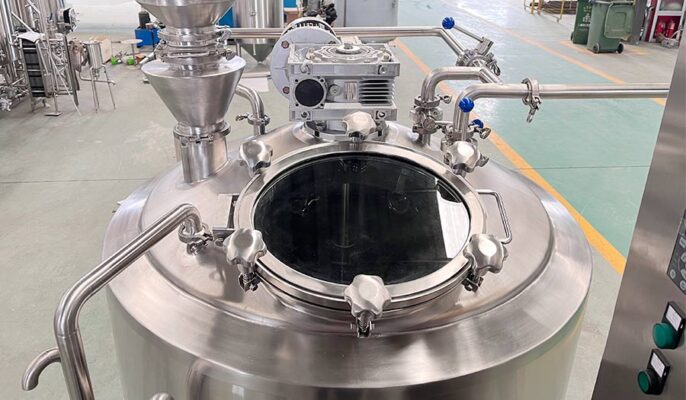
Decoction adds a harder constraint. You cannot boil a thick portion of the mash inside a tun that is supposed to hold the entire grain bed at a gentle rest. You need somewhere to boil that drawn-off fraction, traditionally a mash cooker (or decoction kettle), then return it. That means at least two dedicated mashing vessels before you even count the lauter tun or brew kettle: one to hold the main mash, one to boil the decoction. Breweries that implement decoction on a commercial scale therefore plan for two mash-related vessels, not one. Infusion-only plants can skip the cooker; decoction plants cannot.
Small brewpubs that mash in a lauter tun without a separate cooker are effectively limited to single-step infusion programs, because the vessel geometry and heat transfer are built for sparging, not for pulling thick mash, boiling it, and returning it on a schedule.
Mashing itself usually runs sixty to ninety minutes including heats-up between rests. The head brewer checks conversion with an iodine starch test on a cooled wort sample: iodine turns black-blue if starch remains, and stays reddish-brown when conversion looks complete. Some plants use rapid saccharification monitors instead, but the decision to lauter is always a measured one, not a guess from the clock alone.
Original gravity targets are set here indirectly. You choose grist weight and efficiency assumptions; the kettle will confirm after boil. A 1.050 OG pale ale and a 1.080 OG double IPA start with different grain loads and often different mash thickness, even in the same mash tun.
6. Lautering and sparging
When conversion is complete, the mash moves to lautering: separating sweet wort from spent grain.
A lauter tun has a false bottom or manifold that lets wort drain while grain stays behind. The brewer vorlaufs (recirculates) the first cloudy runoff back on top of the bed until the wort runs clear, compacting the grain bed into a filter.
Run-off flows to the kettle. Sparge water, often 75–78 °C (167–172 °F), showers the grain bed to rinse remaining sugars. Sparge volume and duration affect extract efficiency and tannin pickup; over-sparging or pH drift can pull harsh polyphenols from husks.
A stuck mash stops runoff. Causes include too fine a crush, excessive beta-glucan, or a torn grain bed. Fixes range from raking the surface, raising temp slightly, or in bad cases, blowing the batch. Production planners remember stuck mashes because they ruin a brew day schedule, not just a recipe.
Spent grain exits the lauter to a bin, auger, or farmer pickup. It is wet, bulky, and often used as cattle feed.
7. Boil, hops, and whirlpool
The kettle receives wort and brings it to a rolling boil, typically sixty to ninety minutes.
Boiling serves several jobs at once: sterilizes the wort, drives off volatile off-flavors such as dimethyl sulfide (DMS) from pale malt, isomerizes hop alpha acids into bitter compounds, coagulates proteins (hot break), and concentrates the wort slightly through evaporation.
Hop additions are timed by the clock. Early kettle hops contribute bitterness; additions in the last fifteen minutes or at flameout emphasize aroma and flavor; whirlpool additions below boiling temperature extract oils with less volatilization loss. Hop quantities are calculated in grams per liter or pounds per barrel against target IBU.
After boil, wort transfers to a whirlpool vessel or whirlpool rest in the kettle. Tangential entry spins the liquid so trub (hop and protein sludge) collects in a cone at the center. Clear wort is drawn from the side; trub stays behind.
Boil strength matters for color and Maillard products in the kettle itself, separate from decoction melanoidins. Long boils darken wort slightly and concentrate sugars when evaporation is left unchecked. Brewers measure pre-boil and post-boil volume to track evaporation rate as a brewhouse efficiency metric. A weak boil can leave DMS in pale lagers; an over-vigorous boil costs energy and can darken beer beyond spec.
Hop creep (dry-hop fermentation in package) is a packaging-era problem, not a kettle problem, but the kettle is where IBU is bought. Early additions isomerize alpha acids into soluble bitter compounds; late additions leave oils that survive into the fermenter. Production software calculates utilization from kettle geometry, boil strength, and hop form so the same recipe hits the same IBU batch to batch.
8. Knockout and brewhouse transfer
Hot wort cannot receive yeast yet. Knockout passes wort through a plate heat exchanger counter-current to cold water or glycol, dropping temperature in minutes from near boiling to roughly 7–20 °C (45–68 °F) depending on ale or lager pitch.
Oxygen dissolves more easily in hot wort, so exchanger design and downstream handling aim to limit pickup before controlled aeration. Many breweries inject sterile air or oxygen immediately after the exchanger so yeast cells can reproduce during lag phase. Too little oxygen stresses yeast; too much oxidizes beer later.
Trub from the whirlpool may be separated again in line. The finished chilled wort lines up at the fermenter, ready for pitch.
9. Fermentation
Fermentation turns wort into beer. Brewers pitch a measured mass of Saccharomyces yeast: ale strains (S. cerevisiae) at warmer temperatures, lager strains (S. pastorianus) cooler.
Primary fermentation lasts roughly four to ten days for many ales and one to two weeks for lagers, but gravity curves decide readiness, not the calendar. Brewers track specific gravity daily; when gravity stabilizes near target terminal gravity, primary is effectively done.
Temperature control is non-negotiable on commercial fermenters. Glycol jackets or internal cooling coils hold setpoints within a degree. Lager ferments might peak near 10–14 °C (50–57 °F); ales might sit at 18–22 °C (64–72 °F). Fermentation generates heat; without cooling, yeast would overshoot and produce fusel alcohols and esters outside spec.
A diacetyl rest (brief warm period near end of lager fermentation) encourages yeast to reabsorb diacetyl, which tastes like butter or butterscotch. Ale strains usually clean up faster, but brewers still sensory-check tanks.
Vessel shape matters. Cylindroconical fermenters dominate craft because yeast settles in the cone and can be cropped for the next brew. Open fermenters survive in a few traditional breweries. Some lager producers still value horizontal lagering tanks for yeast pressure and clarity during long cold storage.
CO₂ evolution during active fermentation vents through an airlock or burst disk; later the tank may be sealed and spunded to capture natural carbonation.
Yeast cropping matters for house strains. Brewers draw thick slurry from the cone after a healthy ferment, store it cold for days to a short number of weeks, and repitch into the next batch at a calculated cells-per-milliliter rate. After too many generations, off-flavors accumulate and labs sell a fresh pitch. Wild or mixed-fermentation beers use different organisms entirely (Brettanomyces, bacteria in sours), but the tank still needs temperature control and a plan for cross-contamination.
Pressure and top pressure on fermenters let brewers hold CO₂ in solution during late fermentation, reducing the need for later carbonation gas. That technique shows up more in lager cellars than in hazy IPA programs, where brewers want vents open to avoid picking up sulfur notes from stressed yeast.
10. Conditioning and maturation
Young beer is harsh. Conditioning (or lagering for bottom-fermented styles) smooths flavors, lets yeast finish cleanup, and lets haze particles settle.
Ales might condition a few days to two weeks in the fermenter or a separate conditioning tank. Lagers often age four to eight weeks near 0–4 °C (32–39 °F); some strong lagers go longer. Tank time is money, so production planners balance taste targets against asset utilization.
Dry hopping in the fermenter or a dedicated hop torpedo adds aroma without kettle bitterness. Temperature and contact time control grassiness and polyphenol pickup.
Barrel programs (optional) move beer into wood for weeks or months. That is a parallel track, not the main production line, but it still uses the same core biology after knockout.
Cold conditioning also precipitates chill haze proteins and polyphenols that would otherwise show up in a frosted glass. Some breweries stabilize beer near freezing for a day before filtration so haze does not form in distribution. Others accept haze in wheat beers and leave those proteins in suspension on purpose.
Tank farms are scheduled like airline gates: a fermenter must empty, CIP, refill, and finish on time or the packaging line starves. Brewers talk about “tank turn” the way restaurateurs talk about table turns. That economics is why lager breweries with long aging need many more vessels per annual barrel than ale-focused breweries with fast rotation.
11. Clarification and stabilization
Not every brewery clarifies the same way. Hazy IPA brands skip filtration on purpose. Macro lagers and most export beer need stability in distribution.
A centrifuge spins solids out without removing all yeast as aggressively as sheet filtration. Depth or membrane filters polish beer to near sterile appearance. Finings such as isinglass or PVPP help proteins and polyphenols drop in the tank before filtration.
Pasteurization appears in some high-volume packaging lines to kill residual yeast and extend shelf life at the cost of some fresh flavor. Craft keg beer sold locally often stays unpasteurized and cold-chain dependent.
Turbidity standards differ by brand. A German-style hefeweizen ships cloudy on purpose; an American light lager targets near-zero NTU. The ASBC publishes analytical methods breweries use to measure bitterness, color, dissolved oxygen, and haze so labs compare apples to apples when a batch is held at the tank farm.
12. Carbonation and packaging
Beer leaves fermentation with some CO₂ but rarely at package spec. Brite tanks (bright beer tanks) hold finished beer cold, carbonated to target volumes (often roughly 2.2–2.8 volumes for keg ale, higher for some German wheat beers), and ready for packaging.
Force carbonation dissolves CO₂ under pressure in the brite tank. Natural conditioning in bottle or cask relies on priming sugar and residual yeast; that path needs different line equipment and time.
Packaging lines vary:
- Kegs are cleaned, purged with CO₂ or steam, filled, and sent to accounts. Keg washers are their own small factory.
- Cans run through a depalletizer, rinser, filler, seamer, and date coder at speeds that make a brewpub bottling line look slow.
- Bottles add labelers and case packers; crown caps or screw caps each have failure modes operators learn by sound.
Dissolved oxygen at package is tracked in parts per billion because oxidation makes cardboard flavors within weeks.
Canning lines use counter-pressure fillers to limit oxygen pickup at the seam. Bottling lines may flood bottles with CO₂ before fill. Keg fillers purge with gas, fill from the bottom up, and cap with a speared fitting that bars will later tap. Each format has a different failure mode: seam leaks on cans, crown crimps on bottles, O-rings on kegs. Packaging operators learn to read foam in the glass as a sign of bad fills or warm storage, not just bad brewing.
Date codes and lot stickers tie a case back to a brew log. When a retailer complains about diacetyl in lot 417, the brewery pulls retention samples from that day and checks whether fermentation temperature dipped during the weekend skeleton crew.
13. Quality, traceability, and housekeeping
Release is not automatic when the tank is full. QC labs or inline monitors check ABV, original and final gravity, IBU, pH, dissolved oxygen, CO₂, and microbiological plates on schedule.
Lot codes tie malt, hops, and yeast to each batch for recalls. If a supplier admits a hop lot smells cheesy, the brewery needs to know which cans to hold.
Between batches, CIP runs caustic to remove organic soil, acid to remove beer stone (calcium oxalate), and sanitizer before the next fill. Hose gaskets, sample ports, and heat exchanger plates are common failure points if someone shortcuts the cycle.
Regulatory labeling (TTB in the United States, local rules elsewhere) sits outside the brewhouse but still gates what ships.
Sensory panels run on some schedules: trained tasters score aroma, flavor, and aftertaste against brand standards before a tank releases. Smaller breweries rely on the head brewer and one trusted bartender. Neither approach replaces microbiology; both catch drift before customers do.
Spent yeast and trub go to drain or farm disposal with different rules than spent grain. Trub is acidic and heavy; plants size drains and interceptors accordingly. Environmental compliance is part of the cost of running at scale, even when the taproom crowd only sees the shiny fermenters.
14. How scale changes the same steps
The chemistry does not care whether you brew ten barrels or five hundred. The plant layout does.
Table 1: Brewery scale vs typical equipment
| Segment (BA market segment) | Typical brewhouse batch | Common hot-side vessels | Batches per brew day (typical) | Fermentation | Packaging emphasis |
|---|---|---|---|---|---|
| Brewpub / taproom | 3–15 BBL (3.5–18 HL) | 2-vessel mash-lauter + kettle-whirlpool common | 1, sometimes 2 | Few CCVs behind bar or in back | Kegs to tap; limited cans |
| Microbrewery (<15k BBL/yr) | 10–30 BBL | 2- or 3-vessel; dedicated mash tun appears as volume grows | 1–3 | Cellar of cylindroconicals | Kegs, cans, some bottles |
| Regional / large craft | 60–300+ BBL | 3–5+ vessel brewhouse; dedicated mash tun standard | 4–8+ on large systems | Many large CCVs or horizontal lager tanks | High-speed can lines, distribution |
Source: Brewers Association market segment definitions; brewhouse throughput ranges from commercial engineering references and EPA process descriptions for fermented beverage plants.
Table 2: Brewhouse and cellar vessels
| Vessel | Primary function | Typical 2-vessel system | Typical 4-vessel system | When it becomes dedicated |
|---|---|---|---|---|
| Mash tun | Mix grain and water; enzymatic conversion | Combined with lauter as mash-lauter tun | Standalone vessel | When kettle must stay free for another batch |
| Mash cooker | Boil decoction fraction | Not present | Used with decoction programs | Required for decoction (second mash vessel) |
| Lauter tun | Separate wort from grain; sparge | Combined with mash | Standalone | Medium-high throughput |
| Brew kettle | Boil wort; hop isomerization | Combined with whirlpool | Standalone | Always |
| Whirlpool | Trub separation | Combined with kettle | Standalone | High volume or fast turnover |
| Hot liquor tank | Heated brewing water | Shared | Shared | All scales |
| Fermenter (CCV) | Primary fermentation | Yes | Yes | All scales |
| Brite tank | Carbonation, clarity, package prep | Optional on small | Standard before packaging | When packaging line needs steady feed |
On a fifteen-barrel craft brew day, one person might mill at dawn, mash by 7 a.m., lauter late morning, and knock out before dinner while scheduling yeast pitch. On a regional lager line, the same calendar day might see four brews staggered across separate mash, lauter, kettle, and whirlpool hardware while cellar tanks rotate on a spreadsheet.
Decoction, mash tun dedication, and batch count all pull in the same direction: more vessels when the business needs more beer per square foot of brewhouse, not because textbook diagrams demand stainless for its own sake.
If you tour a brewery and remember only one layout lesson, remember this: the number of tanks on the hot side is a production schedule decision. The beer does not know whether you mashed in a combined tun or a standalone mash vessel, but your accountant knows whether you can sell four brews a week or one.
15. FAQ
What is the difference between a brewpub, a microbrewery, and a regional brewery?
The Brewers Association classifies a brewpub as a restaurant-brewery selling at least twenty-five percent of beer on-site with significant food service. A microbrewery produces fewer than fifteen thousand barrels per year and sells at least seventy-five percent off-site. A regional brewery produces between fifteen thousand and six million barrels annually. Those categories describe business model and volume bands, not whether the beer is good.
Why do some breweries use two brewhouse vessels and others use four or more?
Two-vessel systems (mash-lauter plus kettle-whirlpool) cost less and fit smaller buildings. They trade away parallel processing. Four-vessel plants separate mash, lauter, kettle, and whirlpool so one batch can boil while the next is still mashing, which is how high batch counts happen without buying a second brewhouse.
What is decoction mashing and who still uses it?
Decoction removes part of the mash, boils it, and mixes it back to raise temperature and develop melanoidin malt flavor. German and Czech lager traditions keep it; many modern craft lagers use infusion instead because it saves time and energy. Flavor preference and equipment, not mystery, drive the choice.
How long do fermentation and lagering usually take?
Ales often finish primary in four to ten days at warm temperature, then need shorter conditioning. Lagers commonly ferment cool one to two weeks, then age near freezing for several weeks to months. Strong beers and barrel projects stretch longer.
Do all breweries filter beer before packaging?
No. Hazy styles and many brewpub kegs skip filtration. Beer shipped long distances or held at room temperature on shelves is far more likely to see centrifugation, filtration, or both.
What does CIP mean and why does it matter?
Clean-in-place systems pump chemical solutions through tanks and piping without tearing everything down. Skipping CIP grows biofilms that survive sanitizer on the next run. The beer tastes fine until it does not, and then you lose a tank week.
Can one vessel be both mash tun and lauter tun?
Yes. That is standard on small brewhouses. You usually run infusion mashes because you lack a separate decoction boiler, and you accept that the kettle cannot start another batch until lauter finishes.
16. Works cited
- Briggs, D.E.; Hough, J.S.; Stevens, R.; Young, T.W. Malting and Brewing Science, 2nd ed., Vol. 1: Malt and Sweet Wort. Springer, 1981. https://books.google.com/books?id=bHuCdG5VSmUC
- Briggs, D.E. Malts and Malting. Springer, 1998. https://books.google.com/books?id=s9tf70Wk3bYC
- Bamford, C.W.; Barclay, R. Technology of Brewing and Malting. Institute of Brewing & Distilling, 4th ed., 2010. https://www.ibdlearningzone.org.uk/
- Rabin, Dan; Forget, Carl. The Dictionary of Beer and Brewing, 2nd ed. Taylor & Francis, 1998. https://books.google.com/books?id=XRyxWu8rRnQC
- U.S. Environmental Protection Agency, AP-42, Chapter 9.12.1: Fermented Beverages/Brewing. EPA, 1995 (updated compilation). https://www.epa.gov/sites/default/files/2020-10/documents/c9s12-1.pdf
- Brewers Association, “Craft Beer Industry Market Segments.” https://www.brewersassociation.org/statistics-and-data/craft-beer-industry-market-segments/
- Brewers Association, “Craft Brewer Definition.” https://www.brewersassociation.org/statistics-and-data/craft-brewer-definition/
- Brewers Association Engineering Subcommittee, “Engineering White Paper: Brewery Steam Boilers.” https://www.brewersassociation.org/educational-publications/engineering-white-paper-brewery-steam-boilers/
- Palmer, John J., “How the Mash Makes Wort,” How to Brew (online excerpt). https://howtobrew.com/book/section-3/understanding-the-mash-ph/introduction
- American Society of Brewing Chemists, “Methods of Analysis” (overview). https://www.asbcnet.org/methods/Pages/default.aspx
- Master Brewers Association of the Americas, “Technical Resources.” https://www.mbaa.com/Pages/default.aspx
- Ensminger, Audrey H. Foods & Nutrition Encyclopedia, 2nd ed., Vol. 1. CRC Press, 1994 (mashing overview). https://books.google.com/books?id=o3UD2iL4sAAC
- U.S. Alcohol and Tobacco Tax and Trade Bureau, “Brewers Qualification,” industry guidance. https://www.ttb.gov/regulated-commodities/beverage-alcohol/beer
- Narziss, Werner; Back, Werner. Abriss der Bierbrauerei, 7th ed. Wiley-VCH, 2009 (decoction and lager production). https://www.wiley-vch.de/en/areas-interest/natural-sciences/chemistry-biochemistry-513110/books/978-3-527-33869-4
- Meussdoerffer, Franz G. “A Comprehensive History of Beer Brewing.” In Handbook of Brewing, 2nd ed., ed. Hans M. Eßlinger. Wiley-VCH, 2009. https://onlinelibrary.wiley.com/doi/book/10.1002/9783527623488
For related BevWire coverage, see The Great Beer Reset: 5 Surprising Shifts Redefining the Future of ….